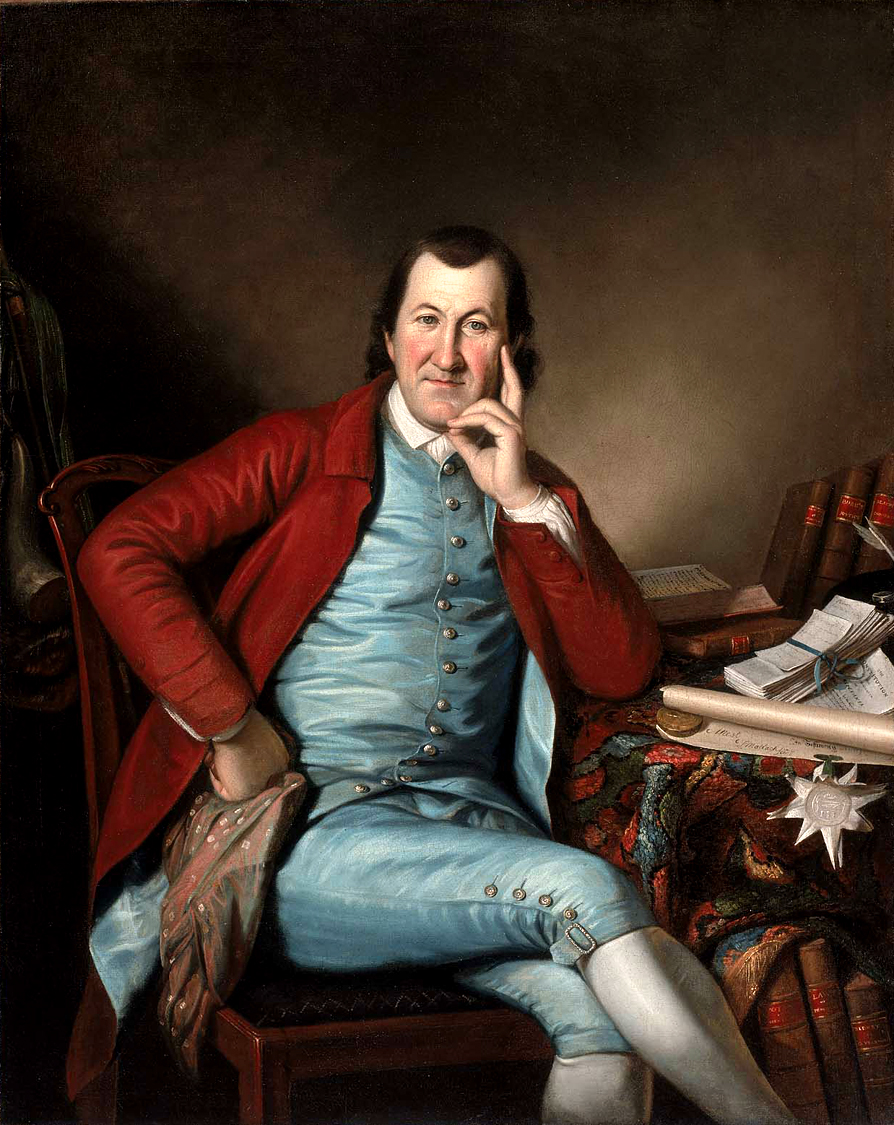
Timothy Matlack
"It was late when the Philadelphians left the Adamses' rooms. The rain had stopped. As the radicals walked home, the moon shone high and bright. A new plan was in effect.
It took to extremes what the radicals had already been doing. Young, Cannon, and Marshall, along with their friends Paine, Matlack and Rush, would no longer merely push socially radical ideas. They would make an actual working-class revolution in Pennsylvania. They would overthrow the keystone province. Their radical government would swing the Continental Congress to independence."
Excerpt from:
Critical Thinking
August 24, 2021
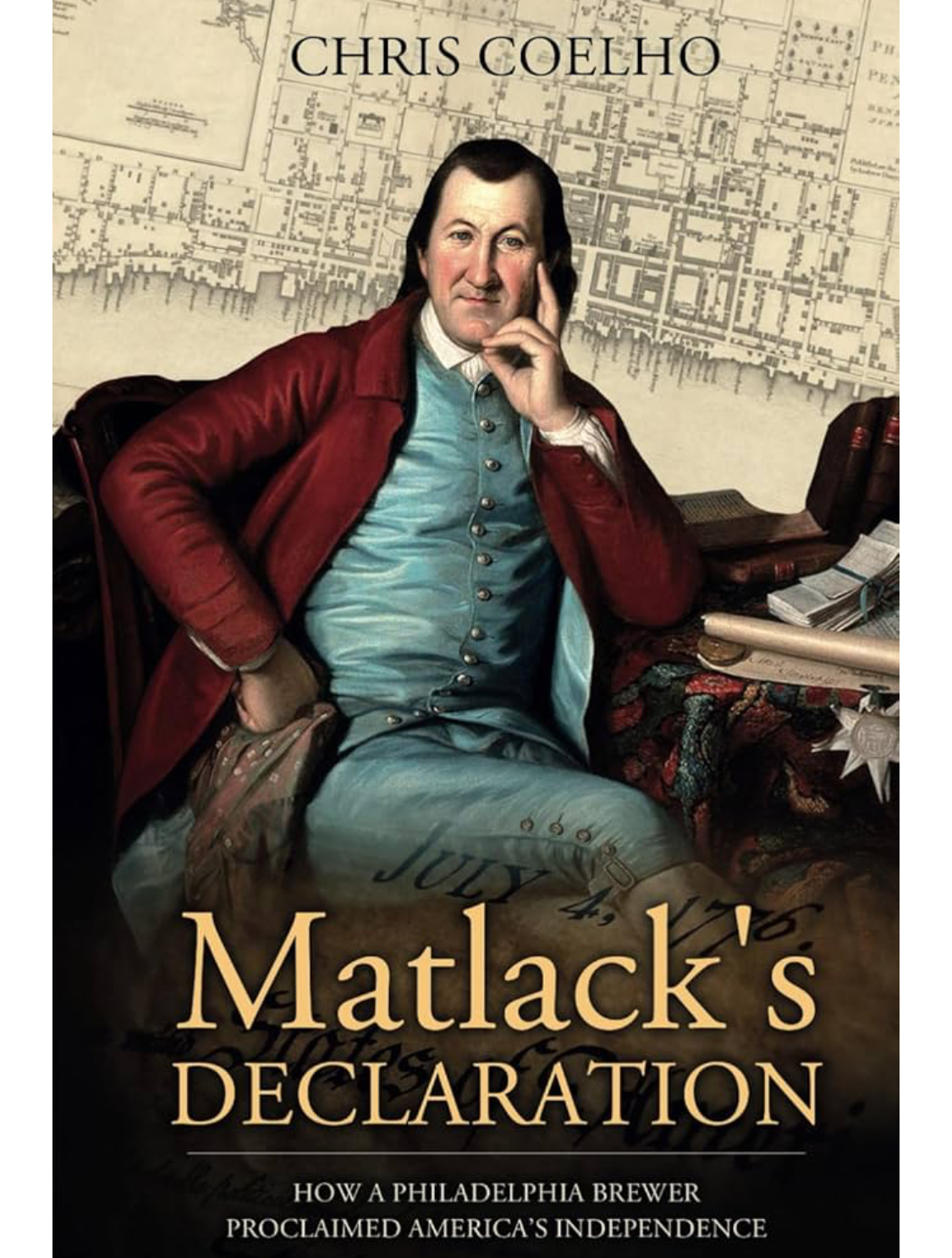
by Chris Coelho
The scribe of the Declaration of Independence—and perhaps the first man to read it in public—was born on March 28, 1736 in Haddonfield, New Jersey. His family moved to Philadelphia eight years later. At the age of thirteen, Timothy Matlack began an apprenticeship under a prosperous Quaker merchant named John Reynell. Looking forward to a bright future, Matlack enthusiastically signed his contract with characteristic looping flourishes. But then disaster struck his family. His father, Timothy Sr., was a brewer who fell into debt, and the court ordered the seizure of his brewery and household goods. A last-minute agreement allowed the continued use of the property but with a new man in charge: Timothy’s half-brother, Reuben Haines. Timothy’s father drank himself to death soon thereafter and his younger brothers were admitted to a charity school as “poor scholars.” After completing the term of his apprenticeship in 1758, Timothy Matlack married Ellen Yarnall, the daughter of a Quaker minister. Matlack became such a devout Quaker that some people considered him a candidate for the ministry. Timothy and Ellen had four children, the youngest of whom would be killed in a battle at sea during the Revolution. In 1759, Benjamin Franklin, as a member of the Pennsylvania Assembly, hired Matlack to transcribe onto parchment a massive petition to the King-in-Council regarding Indian affairs.[1] In 1760, Matlack opened a mercantile (selling cloths and hardware).
In 1765 the Society of Friends complained that Matlack had become negligent in attending meetings for worship, instead “frequenting company in such a manner as to spend too much time away from home.”[2] His new companions kept him away from not only home and church, but also work. He was disowned by the Quakers and his business failed. He was in debtor’s prison on two occasions, each for about a month. Matlack had been raised to live with Quaker simplicity and earn a living in a lucrative trade. But he found himself more interested in the weight of a prize cow, or the length of a racecourse, than the price of linen in London. After his father’s business failure and untimely death, he had found consolation in his faith. But now, after his own fiasco and his mother’s death, he filled the emptiness in the taverns. Yet he did not fall into the abyss. In the alehouses he found an appealing world where men talked trade, politics, and sport over rounds of beer, wine, and rum punch. This was a time of fascination with the public world, and Matlack eagerly joined in these discussions. His friendly manner earned him popularity and acceptance. He discovered an identity which saved him from this second crisis. He was becoming a public man. Matlack’s embrace of public life led to his leadership role in town meetings and committees during the climactic years leading to the Revolution. The first Continental Congress was only ten years away.
Fortunately, Timothy’s half-brother Reuben transformed the old Matlack operation into Haines and Twells, the largest brewery and malt house in Philadelphia. Timothy had his own brewery and bottled beer operation at the “old Brew-House” on Sixth Street, near the State House. He stamped his corks TIM MATLACK PHILAD.[3]
Quakers condoned the moderate consumption of beer, which was made from their barley. But they complained bitterly about “the increase in vice occasioned by the enormous increase of taverns and tippling houses.”[4] The Society of Friends ordered its members not to run horse races or gamble on sports, “for our time swiftly passes away.” For Timothy Matlack and his friends, horse racing was a passion. In the taverns, horse talk reached a fever pitch in the days before Philadelphia’s spring and fall races, which attracted aristocrats from New York and Maryland. A sport equally popular in the middle and southern colonies, among rich and poor alike, was cockfighting. In 1770 Philadelphia hosted a big intercolonial cockmain that pitted a wealthy visitor against a local man of humble origins. On Tuesday, March 6, a clear sunny day, “James Delancey Esq from New York, and Timothy Matlack, had a great cockfight at Richeson’s on Germantown road.”[5] Spectators drank and gambled, and the day ended in a massive brawl. Throughout his political career, Matlack’s enemies took every opportunity to remind people of his link to this discredited sport, as well as to the Black men who were also enthusiastic participants. As the Tory poet Jonathan Odell ridiculed, “game-cocks and negroes were his whole delight.”[6]
Nevertheless, Matlack’s central role in this infamous cockfight earned him a high approval rating across a large swath of regular Philadelphians. His newfound popularity also created social opportunities. In February 1774, he officiated at a patriotic gathering at a slaughterhouse. Timothy recorded the exact weight of each section of a prize steer owned by his friend Jacob Hiltzheimer, and authenticated those figures with the notation that the cow had been “weighed and measured in the presence of T Matlack.”[7] Two days later, the Hiltzheimers and Matlacks dined on beefsteaks. Matlack’s toast was as follows: “Let the friends of America be fed on such beef and may her enemies long for it and be disappointed.”
The Revolution in Philadelphia
On October 25, 1774, the First Continental Congress resolved to send a formal address to the king asking for his royal attention to “the grievances that alarm and distress his Majesty’s faithful subjects in North America.”[8] Secretary Charles Thomson assigned the urgent task of engrossing two copies of the address to Timothy Matlack. Matlack had these ready to sign the next day, the last day of Congress. In January 1775, the first copy was laid before the House of Commons and the second copy laid before the House of Lords. Both were promptly ignored.
The Second Continental Congress convened on May 10, 1775, and five days later Samuel Ward of Rhode Island noted, “The Secretary allowed to employ Timothy Matlack as clerk under an oath of secrecy.”[9] On June 15, Congress appointed George Washington to be general and commander-in-chief of the army of the United Colonies, and Matlack penned the formal commission. Besides being busy in Congress, Matlack was also a rising local leader: that summer, he was elected to Philadelphia’s powerful committee of inspection. This was one of the bodies that formed across the colonies, by order of the first Congress, to enforce the boycott of British goods. Matlack was also named secretary of the committee of militia officers.
In December 1775, Congress took steps to build a naval fleet for “the Defence of America.” The marine committee’s secretary, the ubiquitous Timothy Matlack, worked on specifications for a fleet of gunships. He was also employed by the committee of claims. On January 20, 1776, the member from New Jersey, Richard Smith, noted that, “Some Powder was ordered for the Companies of Maxwell’s who are ready to march to Canada and Tim. Matlack was directed to furnish them with Ball and Flints. Tim is a Commissary and Clerk in Chief to our Committee of Claims.”[10] Smith was amazed that “this person who is said was once a Quaker Preacher and is now Col. of the Battalion of Rifle Rangers at Philadelphia.” (Matlack was not a preacher, of course, but just a member of the Society of Friends.) Early that month the city had added two more battalions to its militia brigade for a total of five. Matlack had been elected colonel of the fifth battalion of riflemen. A year later, he and his men would find themselves facing British regulars on a frozen battlefield.
Also in January 1776, Matlack was named an officer of Philadelphia’s committee of inspection. His promotion came at a critical moment. By now, some in Congress thought autonomy was inevitable. The next step, they realized, was an assertion of separation from Great Britain. Thomas Paine’s widely disseminated pamphlet Common Sense shifted a large swath of the population in the same direction. But a unanimous declaration of independence by Congress would require striking the Pennsylvania Assembly’s instructions to its delegation to “utterly reject” any such proposal. Defying heavy pressure, Assembly leader John Dickinson said he had no intention of removing his prohibition. Yet Matlack’s committee of inspection was gaining power by force of the militia and the people at large. In late February, his board announced a convention that would authorize new Assembly seats and write new instructions. Philadelphia’s elite was shocked by this volley. Joseph Shippen complained:“Tim Matlack and a number of other violent wrongheaded people of the inferior class have been the Chief Promoters of this wild Scheme; and it was opposed by the few Gentlemen belonging to the Committee—but they were outvoted by a great majority.”[11]
The committee backed off when the Assembly agreed to add seventeen seats. John Adams hoped the byelection for these seats would “give a finishing Blow to the Quaker interest.” Matlack’s radicals were victorious in the western counties, but three of their four Philadelphia candidates were defeated. Matlack’s committee failed to gain control of the Assembly. In mid-May, Adams stepped up with a resolution in Congress that said any “authority under the said Crown of Great Britain should be totally suppressed.” Armed with this statement, Matlack’s committee organized a massive town meeting which authorized a provincial conference; a constitutional convention; and a vote for independence. Adams reported:
We have had an Entertaining Maneuvre, this Morning in the State House Yard . . . The Weather was very rainy, and the meeting was held in the Open Air, like the Comitia of the Romans . . . Coll. McKean, Coll. Cadwalader and Coll. Matlack the principal orators.[12]
On June 7, Richard Henry Lee proposed that Congress declare the united colonies free and independent states. But Pennsylvania’s delegates requested a delay in voting. James Wilson explained that although the “majority of the People of Pennsylvania were in Favour of Independence . . . the Assembly . . . was against the proposition.”[13] Under intense pressure, John Dickinson sent down new instructions the next day. But the move came too late to save his government.
On June 10, the Philadelphia militia staged meetings in support of democratic government in Pennsylvania. A published account focused on Colonel Matlack’s fifth battalion. To close the meeting, Matlack asked his men “whether they wished the province of Pennsylvania to be a free and independent State, and united with the other twelve colonies represented in Congress?”[14] The vote in favor was unanimous and all joined in three huzzas. And so—as all read in their newspapers—Col. Timothy Matlack’s battalion voted for independence on June 10, 1776.
On June 14, the Assembly adjourned for lack of quorum and was permanently quashed. The conference of committees, with Matlack in attendance, opened on June 18. The conference soon announced “That they appoint Monday the 8th Day of July next for electing said Members” to the Pennsylvania constitutional convention. In closing their meeting on June 25, the conference addressed Pennsylvania’s militia (known as the Associators) to explain why it had called up 4,500 men. The speaker spoke to the men in local terms:
You are about to contend for permanent Freedom, to be supported by a government which will be derived from yourselves, and which will have for its Object not the Emolument of one Man, or class of Men only, but the Safety, Liberty, and Happiness of every individual in the community.[15]
And he also spoke to them in global terms:
The present campaign will probably decide the Fate of America. It is now in your Power to immortalize your Names, by mingling your Achievements with the Events of the Year 1776—a Year which we hope will be famed in the Annals of History to the End of Time[16]
Congress declared independence on July 4, 1776 and Matlack may have been the first to read the Declaration in public that day. After New York agreed to independence on July 9, Congress ordered the Declaration “fairly engrossed on parchment” and “signed by every member of Congress.” Secretary Thomson assigned this to Timothy Matlack. The result was the famous signed Declaration of Independence.
Harvard professor of political science Danielle Allen spoke of the elegance of Matlack’s work in creating the finest rendering of the Declaration. She described how Matlack made his impact as he drew up the formal document: “Editorializing on the parchment with capitalization, punctuation, and flourishes, Matlack too helped write the Declaration. Of all the copies, this one, Matlack’s parchment manuscript was the most important.”[17]
Timothy Matlack and the War of Independence
When the Pennsylvania convention closed near the end of September, the leaders printed their radically democratic constitution on blue paper and inserted it in the newspapers. John Adams, who disapproved of their unicameral legislature, conceded: “Matlack, Young, Canon and Paine had influence enough to get their democratical plans” adopted in their state.[18] Those opposed to the controversial new framework called a town meeting on October 21. Matlack spoke in support, but a “large majority” wanted changes made by the new Assembly, which was yet to be seated. In the election for seats on November 5, voters rejected Matlack and his fellow Constitutional candidates for Philadelphia. (Matlack, however, was named clerk.) The victorious opposition party, now known as Anticonstitutionalist, called for a new convention.
But then fate intervened: word arrived that British troops were crossing New Jersey and was heading toward Philadelphia. On December 2, Philadelphians panicked when they learned the enemy had reached Brunswick. Patriots loaded wagons in “hurry and confusion.” Preparations for war had one unexpected benefit for the authors and supporters of the constitution: it stopped all talk of holding a new convention.
Colonel Matlack’s fifth battalion and the rest of the Philadelphia militia missed the Battle of Trenton on Christmas Day, 1776. But they joined Washington’s army for the standoff at Assunpink Creek and the great victory at Princeton. From there the winter campaign continued across New Jersey, with the militia suffering relentless cold and hunger. Matlack’s battalion disintegrated at the end of January. But the militia had earned accolades for its unexpected performance:
Great credit is due the Philadelphia militia; their behaviour at Trenton in the cannonade, and at Princeton was brave, firm, and manly: they were broken at the first action at Princeton, but soon formed in the face of grape-shot, and pushed on with a spirit that would do honor to veterans.[19]
In March 1777, Matlack was named secretary of Pennsylvania’s Supreme Executive Council. The fight over the constitution continued and the two sides organized their forces. Matlack’s party called the opposition “wealthy-militia-avoiding-supporters-of-the-Crown.”[20]
On September 26, 1777, Matlack’s friend Jacob Hiltzheimer wrote, “This day the English got into Philad.”[21] When the British occupied Philadelphia, Matlack was in Lancaster with the evacuated government. He was the last member of the 1776 radicals still in office. As Dr. Benjamin Rush told John Dickinson, “Matlack alone remains in power and influence, of all the authors and pillars of the Constitution.”[22]
Following the British evacuation nine months later, General Washington named Benedict Arnold commandant of Philadelphia. But Pennsylvania’s leaders soon grew to despise Arnold’s soirees—much frequented by the Tories—and his illicit business activities. Matlack’s investigation led to a series of charges and a court martial, which was convened in December 1779. The court sentenced the major general to a reprimand by Commander-in-Chief Washington. He issued the reprimand with a statement of personal disappointment, calling Arnold’s actions reprehensible, which was a triumph for Matlack. His investigation of the unscrupulous commander had ended decisively with a severe rebuke from Washington. With the conclusion of the Arnold affair, Matlack’s star was once again on the rise.
On March 1, 1780, the Pennsylvania Assembly passed an Act for the Gradual Abolition of Slavery, the first law of its kind in the Western Hemisphere. The law declared that the children of current slaves would serve terms as indentured servants. Their children, the grandchildren of the current slaves, would be born free. George Bryan told Samuel Adams that the new law thrilled the Society of Friends: “Our bill astonishes and pleases the Quakers. They looked for no such benevolent issue of our new government, exercised by Presbyterians.”[23]As secretary of the Supreme Executive Council, Matlack worked closely with George Bryan, Thomas Paine, Charles Willson Peale and Anthony Benezet to win passage.
Over a five-year period Matlack had amassed significant power and influence. Now he was sent to Congress “with loud huzzas.” His enemies were displeased with his promotion, and responded by attacking him in public with a smear campaign. A man named Whitehead Humphries went to the trouble and expense of printing a sixty-line satire entitled An Epistle from Titus to Timothy.[24] Whitehead’s eager audience agreed that Matlack had been “wretched poor” and “idled time with Negroes.” In the author’s retelling Timothy and his cohorts had taken power by ruling the mob: “With Paine and Peale, you mounted the stage, To work the people into a rage.” Whitehead ridiculed Matlack’s appearance at a Fourth of July banquet:
At such a time you judg’d it best
To have yourself superbly drest;
You were so greased and puff’d with powder,
No coxcomb sure cou’d e’er look prouder;
Until the festive board was laid,
Then knife and fork you briskly play’d.
Your auk’ard grandeur deserves a check.[25]
Matlack’s fellow congressman, Ezekiel Cornell, likewise observed: “He hath a great notion of being a courtier; perhaps in some countries he would appear a course courtier.” Matlack was, in fact, pleased with his advancement. He may have felt, perhaps, a bit stunned to find himself seated among the nation’s leaders. He hoped to earn the respect of men like Thomas Jefferson and Richard Henry Lee, so the opinion of such tertiary figures as Humphries and Cornell was of little concern. Nevertheless, that poem stung, and Matlack was a fighter. Whitehead Humphreys got a taste of Matlack’s displeasure when the two crossed paths on Market Street on New Year’s Day and, “after some fine words . . . got to blows.”
In September 1780, Gen. Nathanael Greene reported, “TREASON of the blackest dye was yesterday discovered . . . Arnold the traitor has made his way to the enemy.” Philadelphia broke into a spontaneous celebration of America’s salvation, taken as a sign of the new nation’s hallowed destiny. The discovery of Arnold’s treason was another vindication for Timothy Matlack, who had pursued the officer relentlessly.
After the War
Matlack was on top, but now a series of setbacks and miscalculations allowed his enemies to get the upper hand. In control of the Assembly and the Supreme Executive Council in 1783, the opposition drummed up charges and denounced the secretary as “unworthy of public trust and confidence.” Matlack was forced to resign. Having received no support from his own party, Matlack was hounded out of government without objection. Soon Matlack was vindicated in court, but he caused more trouble for himself by requesting reimbursements. The financially constrained ex-secretary filed claims “to the amount of one thousand and five hundred pounds and upwards on one account only besides divers others.” Republicans retaliated with a series of judgments, and Matlack was arrested on May 1, 1787. The timing of his detention was calculated to overlap with the start of the United States constitutional convention. Jacob Hiltzheimer wrote that George Washington arrived for the convention on Sunday, May 13: “The City Troop of Horse received him at Mr. Gray’s Ferry. The artillery company saluted with firing the cannon.”[26] Matlack likely could feel the cannon reverberations from his jail cell, but a sympathetic judge soon released him. In August 1787, Washington visited the steel furnace owned by Timothy’s brother White, and later that month, one or both Matlack brothers attended a dinner at Washington’s residence.
On April 8, 1790, Matlack’s Society of Free Quakers presented a congratulatory address to President-elect George Washington. Matlack’s mentor, Benjamin Franklin, died on April 17. Jacob Hiltzheimer wrote, “I think I never saw so many people collected together at any funeral whatsoever.” That year Matlack was named clerk of the new state senate, which sat under the new state constitution. Matlack’s wife Ellen Yarnall died in 1791. Six years later he married Elizabeth Claypoole Cooper.
In the campaign for governor in 1799, Matlack was closely allied with the Democratic-Republican candidate, Thomas McKean. McKean was victorious, and at the end of November he arrived triumphantly in Lancaster. At a feast in his honor, four hundred citizens took seats around a three-hundred-foot table. Matlack offered one of the seventeen toasts that were all saluted by the militia. A parade escorted the governor to his lodgings at Timothy Matlack’s house.
McKean’s victory was a harbinger of the presidential election of 1800. In the battle in Pennsylvania for electoral college seats, Matlack was, as always, attacked by the opposition. This time adversaries dusted off a revolutionary-era anecdote:
The Cockfighter, Timothy Matlack having one day gaff’d himself, by putting on a long sword, was met by a friend (Quaker) who wished to know why he wore a Rapier—Tim replied, it was to defend his liberty and his property. As to property, rejoined the friend, it is well known that thee never hadst any; and as to thy liberty, thou art now indebted to thy creditors for that.[27]
But Matlack won his electoral seat and cast his two votes for Thomas Jefferson and Aaron Burr. The revolution of 1800 and the rise of Jeffersonian democracy was another triumph for Matlack. With their ultra-democratic constitution, Matlack and the Pennsylvania radicals of 1776 sowed the seeds of a more egalitarian American society. Jefferson’s Democratic-Republicans were the heirs to that legacy.
In March 1807, President Jefferson wrote to thank Matlack for a gift. “You have very much gratified me by the collection of choice fruit trees you have been so good to forward me. It is gone to Monticello to which I will follow in a few days.”[28]
In the spring of 1812, at the age of seventy-six, Timothy Matlack was job hunting. He sent a letter to Thomas Jefferson asking for a referral. Jefferson forwarded it to President James Madison, writing:
Timothy Matlack I have known since the first Congress to which he was an assistant secretary. He has always been a good whig & being an active one has been abused by his opponents, but I have ever thought him an honest man. I think he must be known to yourself.[29]
Matlack was not appointed by Madison, but he held various offices in Pennsylvania over the next ten years. Finally, the governor forced him to retire at the age of eighty-six. In 1821, on the forty-fifth anniversary of independence, America took special care to honor its aging revolutionary generation. (Nobody could predict how many of the old heroes would be alive for the semicentennial five years later). Newspapers around the country picked up the story of Philadelphia’s Fourth of July celebration. Timothy Matlack was honored as “the man, who, by order of the Old Congress, wrote the first commission for General Washington—who fought in defense of the same principles, and through his life has maintained them—Our Venerable Chairman, TIMOTHY MATLACK—the adoption and establishment of which he had not inconsiderably contributed.”[30]
In 1825, near the end of his grand tour of America, the Marquis de Lafayette honored Matlack by visiting him at his home in Holmesburg, Pennsylvania. Lafayette might have been the first to show Matlack the reproduction of the signed Declaration of Independence known as the Stone engraving. First distributed in 1824, Lafayette had been given two copies. In 1828, Timothy was visited by a nephew, who wrote: “He was clad in a loose morning gown and a white cap somewhat resembling a turban, and his highly interesting countenance, his sightless, but expressive eyes and long white beard, indicated an age not normally alloted to mortals.” The nephew inquired after his health and Timothy replied: “I scarcely know how I am, or who I am,—where I am or what I am—I only know that I am alive and that’s all.”[31] But Timothy could still recall images of his childhood. He saw his grandfather carrying him to school on his back, “at a time when there was deep snow.” In summertime he saw himself climbing “a certain tree standing in John Gill’s orchard, getting apples.” His life, in the end, was extraordinary. He took the stage in the revolution; he led militia into war; he helped create a democratic government; and he helped free the children of slaves.He died in 1829.
As the man who engrossed the Declaration of Independence, Timothy Matlack should have a place in American lore. But as one contemporary adversary predicted, Matlack was scrubbed from history. Historian Gary Nash writes that in the nineteenth century the radicals of 1776 were ignored by Philadelphia’s archivists and librarians. Further,
The papers of the radicals were lost or never preserved, and most of the officers of the collecting institutions were as suspicious of ordinary people elected to high places as were those who, at the time, deplored the 1776 [Pennsylvania] Constitution.[32]
Nash concluded that the conservative establishment disapproved of the radicals’ desire for “a thorough reformation of American society in the interest of greater equality.”[33]
Most prominent among those given the cold historical shoulder was Thomas Paine. The nineteenth century was nearly over before the Historical Society of Pennsylvania got around to purchasing a copy of Common Sense for its collection. The copy was the very one “owned by Paine’s radical, warm-tempered compatriot, Timothy Matlack.”[34]
[1]Indian 1683-1794 Collection, (Phi), 1,297, Historical Society of Pennsylvania, Philadelphia.
[2]Notice of disownment issued by Philadelphia Monthly Meeting to Timothy Matlack, July 26, 1765 reprinted in A.M. Stackhouse, Col. Timothy Matlack: Patriot and Soldier (privately printed, 1910), 67.
[3]Pennsylvania Gazette, May 8, 1766.
[4]Peter Thompson, Rum Punch and Revolution: Taverngoing and Public Life in Eighteenth-Century (Philadelphia: University of Pennsylvania Press, 1999), 48.
[5]Jacob Hiltzheimer Diaries, March 6, 1770, American Philosophical Society, Philadelphia (APS).
[6]Jonathan Odell, ed. The Loyal Verses of Joseph Stansbury and Doctor Jonathan Odell (Albany: J. Munsell, 1860), 118.
[7]Hiltzheimer, February 1767, APS.
[8]Worthington C Ford, ed., Journals of the Continental Congress, 1774-1789,Vol. I, 1774 (Washington, DC: Library of Congress, 1904), 53.
[9]Samuel Ward Diary, May 15, 1775, in Letters of Members of the Continental Congress (Washington, DC: Carnegie institution of Washington, 1921), 91.
[10]Richard Smith Diary, January 20, 1776, ibid., 323.
[11]David F. Hawke, Benjamin Rush; Revolutionary Gadfly (Indianapolis: Bobbs-Merrill, 1971),144.
[12]John Adams to James Warren, May 20, 1776, Collections of the Massachusetts Historical Society (Boston, MA: Massachusetts Historical Society, 1917), 250.
[13]David F. Hawke, Transaction of Free Men: The Birth and Course of the Declaration of Independence (New York: Hachette Books, 1964),129.
[14]Peter Force, ed., American Archives, Fourth Series Vol 4 (Washington, DC: Peter Force, 1846),786.
[15]The proceedings relative to calling the conventions of 1776 and 1790 (Harrisburg, PA: J. S. Wiestling, 1825), 44.
[16]Ibid.
[17]Danielle Allen, Our Declaration: A Reading of the Declaration of Independence in Defense of Equality (New York: W.W. Norton & Co., 2014), 77.
[18]John Keane, Tom Paine: A Political Life (London: Bloomsbury Publishing, 1995).
[19]William Young, “Journal of Sergeant William Young,” Pennsylvania Magazine of History and Biographyvol. 8 no. 3 (October, 1884), 261.
[20]Samuel Hazard, Colonial Records of Pennsylvania, vol. II (Harrisburg: T. Fenn & Co., 1852), 140.
[21]Jacob Hiltzheimer Diaries, APS.
[22] Steven Rosswurm, Arms, Country and Class (New Brunswick, NJ: Rutgers University Press, 1987), 158.
[23]Robert L. Brunhouse, The Counter-Revolution in Pennsylvania, 1776-1790 (Harrisburg, PA: Pennsylvania Historical Commission, 1942), 254.
[24]“An Epistle From Titus to Timothy,” 1781, Am 1781, Epi 962, F 155 Library of Congress.
[25]Ibid.
[26]Jacob Hiltzheimer Diaries, APS.
[27]Gazette of the United States October 1, 1800.
[28]Edwin Morris Betts, ed., Thomas Jefferson’s Garden Book (Chapel Hill: University of North Carolina Press, 2011), 343.
[29]Paul L. Ford, ed., The Writings of Thomas Jefferson, Vol IX 1807 – 1815 (New York: GP Putnam’s Sons, 1898), 353.
[30]Haverhill Gazette, July 20, 1821.
[31]Friend’s Review vol. 15 no. 45 (July 12, 1862), 706; The Casket vol. 5 no. 2 (1831), 63.
[32]Gary B. Nash, First City: Philadelphia and the Forging of Historical Memory (Philadelphia: University of Pennsylvania Press, 2006), 102.
[33]Ibid., 87.
[34]Ibid.
By the spring of 1776 Philadelphia moderates and radicals comprised coherent and well-organized parties. The moderates, led by John Dickinson, Robert Morris and Benjamin Rush, had the allegiance of a majority of the electorate. This group, which held out for accommodation with Britain, feared the havoc that revolution would cause to Pennsylvania's intricate economic and social system. The radicals, led by George Bryan, Timothy Matlack, James Cannon, Thomas Young and Thomas Paine, had the zeal of new converts to political action. They also had the support and consultation of the principle advocates of independence in the Continental Congress meeting in Philadelphia. Pennsylvania's delegates in Congress had been instructed by the Assembly not to vote for independence. Every move by the radicals to repeal the instructions had failed.5 Concerned that the tendencies of the provincial governments were too conservative, Richard Henry Lee frustratingly declared: "The Proprietary Colonies do certainly obstruct and perplex the American machine."
The Pennsylvania Revolution
This piece was specially commissioned in 1989 from Dr. Roland M. Baumann, an acknowledged
authority on early Pennsylvania political history.
by Dr. Roland M. Baumann, Oberlin
Colonel Timothy Matlack Jr. served with 4th Battalion, Philadelphia City Militia, Pennsylvania Militia during the American Revolution.
"Timothy Matlack the 2nd was born in Haddonfield, New Jersey, to Martha Burr and Timothy Matlack, a Quaker merchant and brewer. The family moved to Philadelphia in 1746. In 1758 young Timothy married Ellen Yarnall, the daughter of Quaker preacher Mordecai Yarnall; they had five children. After the death of his first wife, Matlack in 1797 married widow
Elizabeth Claypoole Copper."[1]
As clerk to the secretary of the Second Continental Congress, Matlack penned the official version of the Declaration of Independence on display in the National Archives.
MATLACK, Timothy, a Delegate from Pennsylvania; born in Haddonfield, Camden County, N.J., in 1730; attended Quaker schools in Haddonfield and Philadelphia; engaged in mercantile pursuits in Philadelphia; was in command of a battalion of “Associators” during the Revolution; member of the provincial conference held in Carpenters’ Hall, Philadelphia, June 18, 1775; delegate to the convention of July 15, 1776, and appointed secretary of state; member of the committee of safety in 1776; in 1777 was appointed keeper of the great seal; member of the board of trustees of the University of Pennsylvania in 1779; Member of the Continental Congress in 1780; moved to Lancaster, Pa.; master of the rolls of Pennsylvania 1800-1809; moved to Philadelphia and was prothonotary of the district court for several years; member of the board of aldermen 1813-1818; died at Holmesburg, near Philadelphia, Pa., April 14, 1829; interment in the Free Quaker Burial Ground, Philadelphia, Pa.; reinterment in 1905 in Fatlands, on the Schuylkill River, opposite Valley Forge, Pa. Timothy Matlack was the founder of the "Fighting Quakers." From The
Lives of Eminent Philadelphians:
"TIMOTHY MATLACK: This patriot of the American Revolution deserves a conspicuous place in history. He was one of the “ General Committee of Safety, 'who met almost every day, during the war, at the Coffee House, State House, or Philosophical Hall, to consider the welfare of the cause and the defence [sic] of the country. He was one of the associates of Thomas Paine, James Wigdon, Robert Hare, Colonel Roberdeau, Christopher Marshall, and others. His name appears often in Christopher Marshall'sDiary, as one of the most active spirits of the days of 1775–6. His example was worthy of the cause, and led many to follow his footsteps. He was considered somewhat eccentric in his manners and ideas, but his patriotism and valor were undoubted.
"Chiefly from this difference of opinion, as well as to the propriety of oaths of allegiance, and the right or power in any sectarian body of disownment or excommunication, grew the formation of the Society of Free Quakers, or as they were frequently called, Fighting Quakers. 'This body, of which Mr. Matlack was one of the founders, was not numerous, but highly respectable. He was instrumental in raising a large sum of money for building the Free Quaker meetinghouse, southwest corner of Fifth and Arch Streets. Among those whose names were obtained to the subscription list are seen Benjamin Franklin , Robert Morris , John Cadwalader , Samuel Wetherill , and others of equal renown. The property thus obtained, as well as the burying - ground in Fifth Street below Prune Street, is now held by the Society. The latter was granted to the Free Quakers, in trust for a burying - ground, the 26th August, 1786, by the Legislature of Pennsylvania.
"Timothy Matlack was truly a Philadelphian, and truly an American citizen and soldier. He became a colonel in the army, and had the command of a battalion 'to whom he had the resolves of Congress of the 15th of May, 1776, and the resolves made the 20th of May, 1776, at the State House, read, when it was proposed whether they should support them at all hazards, and the same was agreed to unanimously. ” In Duane's “ Marshall's Remembrancer ” we find the following : 'June 14th, 1776, yesterday an express came from Harry Fisher of a numerous body of Tories assembled in Sussex County, State of Delaware, who were intrenching and had cut off the communication by land to Dover . ... Powder and ball were sent from here under escort of a company of Colonel Matlack's battalion.'
"On the 14th June, 1776, he was elected one of the Deputies to attend the conference from the City and Liberties, together with Benjamin Franklin, Thomas McKean, S. Delany, John Cox, John Bayard, G. Schlosser, C. Ludwig, J. B. Smith, James Milligan, B. Loxley, C. Marshall, Sen'r, JosephMoulder, F. Gurney, J. Schriner, J. Deane, J. Barge, Dr. Rush, S. C. Morris, William Coates, S. Brewster, J. Blewer, William Robinson, G. Goodwin, and William Lowman.
"When he first wore his sword in the streets of Philadelphia, some of his quondam Friends, or Quakers, belonging to meeting, sought to ridicule his side arms, asking him what it was, to which he replied, 'it was to defend his property and his liberty.' It afterwards proved that he not only knew how to wear his sword, but how to use it to some effect. "Colonel Matlack lived to be upwards of ninety - nine years of age, and retained his faculties to the last in a remarkable degree. In his youth, he was a close observer of passing events, and in old age, it was delightful to listen to his reminiscences of the past. "He was born at Haddonfield, New Jersey, in the year 1730, and died near Holmesburg, Pennsylvania, April 15th, 1829, and was interred in the Free Quaker burial - ground, South Fifth Street, Philadelphia. "Colonel Matlack held office under the early Government of the State, and was 'Master of the Rolls' for many years, residing at Lancaster, where he continued to reside for a long time. Late in life he was appointed Prothonotary of one of the courts in the city of Philadelphia. Timothy Matlack Bryan, Esq., his grandson, now living ( 1859 ), has in his possession, given to him by the family, in consequence of bearing his name, a silver urn, presented to Colonel Matlack by 'The Committee of Safety of the City of Philadelphia,' for his patriotic devotion to the cause of freedom, and the many services rendered by him during the entire struggle, and up to the acknowledgment of the independence of the Colonies by Great Britain, in the Treaty of Peace, Anno Domini 1783. Indeed, Colonel Matlack was conspicuous in all the public measures of the War of 1776, was a popular and successful candidate to public offices; and finally, raised himself a respectable name and estate."[2]
Revolutionary War Service
MATLACK, TIMOTHY, DAR Ancestor #: A075297[3]
Service: PENNSYLVANIA
Rank(s): COLONEL, PATRIOTIC SERVICE
Birth: 4-26-1734 HADDONFIELD GLOUCESTER CO NEW JERSEY
Death: 4-14-1829 HOLMESBURG PHILADELPHIA CO PENNSYLVANIA
Service Source: PA ARCH, 3RD SER, VOL 10, P 761; 2ND SER, VOL 3,
PP 585, 599; 5TH SER, VOL 5, P 13; PAPERS OF THE LANCASTER CO
HIST SOC, VOL XLII, #6, P 150; MIN OF THE SUPREME EXEC
COUNCIL, VOL 11, P 174
Service Description: 1) RIFLE BATT, PHILADELPHIA CITY; COMMITTEE
FOR ESSAYING A DECLARATION 2) SEC, SUPREME EXEC COUNCIL;
MEMBER OF COUNCIL OF SAFETY; CLERK, 2ND CONGRESS
Sources
1. ↑ University of Pennsylvania University Archives and Records
Center. “Timothy Matlack (c.1730 - 1829),” PENN BIOGRAPHIES,
n.d., https://archives.upenn.edu/exhibits/penn-people/biography/timothy-matlack
2. ↑ Simpson, Henry. The Lives of Eminent Philadelphians, Now
Deceased: Collected From Original and Authentic Sources.
Philadelphia, PA: William Brotherhead, 1859. Pages 685-687.
3. ↑ Daughters of the American Revolution, DAR Genealogical
Research Databases, database online, (http://www.dar.org/ :
accessed March 27, 2015), "Record of Timothy Matlack", Ancestor #
A075297.• US Encyclopedia of American Quaker Genealogy, Vol. II (Reference
of Timothy's date of death and of marriage to Ellen and of son
William's birth date) Ancestry.com Image ($)
• DID MATLACK PEN GREAT DECLARATION ? Quaker Clerk of
Continental Congress wrote with Best Hand at His Time Philadelphia
Inquirer ( Philadelphia, PA). Friday Morning, November 10th, 1916.
Pg. 16, 4th column.
• "New Jersey Deaths and Burials, 1720-1988," index, FamilySearch
link to record, Timothy Matlack, 14 Apr 1829; citing , reference ; FHL
microfilm 542522.
• Col. Timothy Matlack, patriot and soldier, a paper read before the Gloucester County Historical Society at the Old tavern house, Haddonfield, N. J., April l4, 1908 (1910) By Dr. A.M. Stackhouse
Published 1910. digital image at Archive.org
• Haverford College; Haverford, Pennsylvania; Minutes, 1757; Collection: Philadelphia Yearly Meeting Minutes [1]
Timothy Matlack
Marriage Date: 27 Oct 1758
Marriage Date on Image: 27 Tenth 1758
Marriage Place: Philadelphia, Pennsylvania
Spouse: Ellin Yarnall
Philadelphia Monthly Meeting
Philadelphia Yearly Meeting
Meeting State: Pennsylvania Meeting County: Philadelphia
Simpson, Henry. The Lives of Eminent Philadelphians, Now Deceased:
Collected From Original and Authentic Sources. Philadelphia, PA: William
Brotherhead, 1859. Pages 685-687.
For more check out...


